



|
| Please Support our Sponsors |
 |
 |
||
 |
 |
Development Projects
|
Design, Development, Engineering and Production Of Armored Cars (1940-1944) |
||
|
This edition, edited, annotated and illustrated by David R. Haugh |
||
|
As has been stated, the Special Armored Vehicle Board in December 1942 outlined the general characteristics of the armored car of the future. On 12 December 1942, in accordance with this report, the Chief of Ordnance received direction from Headquarters, Service of Supplies, that a project be begun for the development of an armored car having the characteristics outlined by the Special Armored Vehicle Board. |
||
|
|
||
|
It was recommended in March 1943 that pilots of these two vehicles be procured. Contract was entered with Studebaker Corporation, South Bend, Indiana for the design and manufacture of one pilot armored car T27, the 8x6 vehicle. Contract was also entered with the Chevrolet Division, General Motors Corporation for the design and manufacture of one pilot armored car T28, the 6x6 vehicle.
|
||
|
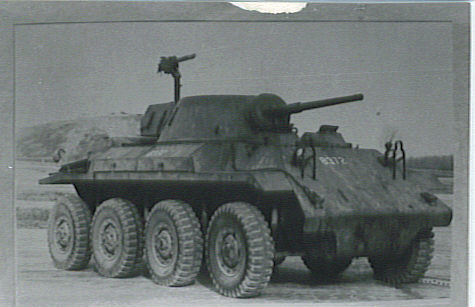
Car, Armored, T27. Designed by Studebaker, the vehicle was an 8x6, with the third axle from the front being a non-powered unit. (Photo: US Army) |
||
|
The armored car T27 weighed 15,200 pounds (6901kgs) with load, had a road speed of 61 miles an hour (98.2km/h) and was an 8x6 vehicle incorporating 9.00x16 combat tires. The car was powered by a Cadillac V-8 engine of 130 horsepower, located in the rear. Transmission was hydromatic, and steering was mechanical through the four front wheels. The car was armed with a 37mm gun, turret mounted, with an elevation from minus 10 degrees to plus 20 degrees and a traverse of 360 degrees, a caliber .30 machine gun mounted above the turret for antiaircraft use and a caliber .30 machine gun coaxially mounted with the 37mm gun. The car had eight speeds forward and four reverse. It was 204 inches (5182mm) long, 78 inches (1981mm) high, 90 inches (2286mm) wide, with a ground clearance of 14 inches (356mm), wheelbase of 132 inches (3353mm), and a safe fording depth of 48 inches (1219mm). The armor was .375-inch (9.53mm) on front, sides, and rear, while the turret armor was .75-inch (19.05mm) and that of the top .25-inch (6.35mm). The car was designed to carry a crew of four men.
|
||
|
The pilot [T27] was demonstrated at General Motors Proving Ground, and with the light armored car T28 was compared in performance with the armored car M8 with the standard JXD Hercules engine, and with an armored car M8 with the JXLD Hercules engine. Further tests were made at Aberdeen Proving Ground and Fort Riley, Kansas, by the Cavalry Board. A report by the Cavalry Board of 9 May 1944 recommended that no further consideration be given this vehicle as a replacement for, or a vehicle supplementary to, the armored car M8. The project was terminated in July 1944.
|
||
|
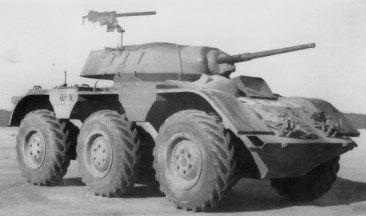
The armored car T28 (Also called the M38 Wolfhound) weighed 14,500 pounds (6583kgs), loaded, and had a road speed of 59 miles an hour (94.9km/h). This car, like the T27, was powered by a Cadillac V-8 engine of 130 horsepower, located in the rear of the vehicle and was a 6x6 incorporating 12.00x20 special combat tires.
|
||
|
The armament was identical with that of the T27, while the car itself was slightly wider than that vehicle and had a wheelbase of 118 inches (2997mm). The armor was the same as that of the T27. The car had eight speeds forward and two in reverse, and carried a crew of four men.
|
||
|
|
||
|
Car, Armored, T28. Impressed by the car’s performance, the Cavalry Board recommended that the vehicle be standardized as the M38 Wolfhound. (Photo: US Army) |
||
|
At the conclusion of tests, the Cavalry Board, on 5 May 1944, submitted a partial report recommending that, subject to successful modification as recommended, the vehicle be placed in early production and replace the armored car M8; and with suitable modification of the hull, replace the armored utility car M20. The Development Division, Office, Chief of Ordnance-Detroit, outlined to Headquarters, Army Service Forces, a recommended procedure regarding modifications, pointing out the time and expense involved in making the changes in a second pilot model, and that none of the changes demanded service testing to prove its tactical suitability. To date, no decision has been received. Action is being withheld early in 1946 pending further advice.
|
||
|
The pilot T28 has been shipped to Fort Knox, Kentucky, for a cross-county test to determine its ruggedness and durability.
|
||
|
The winterization of armored cars was begun 5 July 1942, and work was started on armored cars T17, T17E1, T17E2, T18E2, upon light armored car M8 and upon armored utility car M20. Work on armored car T18E2 was dropped when it became apparent that this car would not reach production.
|
||
|
Pilot vehicles were diverted from production. Each vehicle was prepared by the manufacturer of the vehicle itself, making use of the experience and recommendations of Armored Force Board Report 259-1 and the S.A.E. Cold Starting Committee. All work was coordinated by the Ordnance Department. A typical winterization kit for this class of vehicle consists, in general, of heaters for engine, battery, and crew compartment, engine primer, special windshield with built-in defrosters, clear-vision turret cover, and engine air inlet and outlet shutters. Each vehicle was given a cold room test at minus 40 degrees Fahrenheit at the Oldsmobile Engineering Laboratory, Lansing, Michigan, under the supervision of personnel from General Motors Proving Ground.
|
||
|
The armored car T17 was tested during the winter of 1942-43 by the Winter Test Detachment at Camp Shilo, Manitoba, Canada. The armored car M8 and armored utility car M20 did not become available for pilot installation until the spring of 1943. Improvements found desirable were applied to these vehicles.
|
||
|
Development on the armored car T17 was dropped since only a few vehicles were to be produced. The kit for the armored car T17E1 was completed, and this car and the armored car M8 and the armored utility car M20 were tested at Dawson Creek, British Columbia, during the winter of 1943-44. Minor improvements in winterization kits for these vehicles were made. The project on armored cars T17E1 and T17E2 was dropped due to lack of interest on the part of the British.
|
||
|
The winterization Section, Development Division, OCO-D, is acting in an advisory capacity to the vehicle project engineer on winterization kits for armored cars T27 and T28.
|
||
|
Development work on fording kits for armored cars is being carried on as a phase of Project KG-260; Fording Equipment for Transport Vehicles.
|
||
|
In June 1943, a kit applicable to light armor car M8 was completed and demonstrated. Materials for this kit included intake and exhaust extensions, ventilating hose and tubing, sealing and insulating compounds, wire, clamps and adapters, waterproof tape, and asbestos grease. This kit is also applicable to the armor utility car M20.
|
||
|
No work has been done on providing permanent waterproofing equipment for any specific model of armored car, except the application of waterproof components and permanent sealing devices. |
||
|
|
||
| Previous Page | Return to Article Index | Next Page |
| Copyright: David Haugh - August 2006 | ||