




|
| Please Support our Sponsors |
 |
 |
||
 |
 |
Medium and Heavy Armored Cars
(1940-1942)
|
Design, Development, Engineering and Production Of Armored Cars (1940-1944) |
||
|
This edition, edited, annotated and illustrated by David R. Haugh |
||
|
The development of the armored car was affected by the formation of the Armored Force in June 1940, and by the progress of the war in Europe. The Wehrmacht had over-run the Low Countries and France, and there was renewed requirement for a wheeled and turreted reconnaissance vehicle having greater speed and greater radius of action than the existing track-laying vehicles. This need was confirmed by the campaign in North Africa. Rapid development in the field of medium and heavy armored cars followed. The first result was the development, test, and ultimate rejection of the Armored Car, T13.
|
||
|
|
||
|
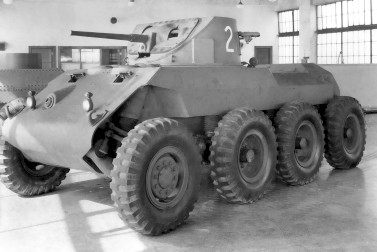
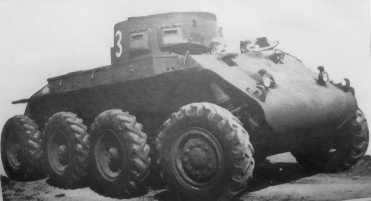
This vehicle was an 8-wheeled car, with drive on the three rear axles, steered with the two front wheels as well as by an auxiliary differential steering system. All eight wheels, supported by pneumatic shock struts, had individual suspension. The car was powered by a radial Guiberson Diesel engine, air-cooled, 9-cylinder, of 250 horsepower. The car was planned to carry one 37mm gun and a caliber .30 machine gun mounted in a turret with 360 degree traverse, and one caliber .30 machine gun for use by the assistant driver. The armor thickness planned was front, .625-inch (15.9mm), sides, top and rear, .5-inch (12.7mm) and turret 1-inch (25.4mm). |
||
|
|
||
|
|
||
|
A demonstration model, commercially developed and without turret or armor plate, was tested by the Armored Force Board in March 1941. Procurement of two vehicles for test was authorized in April 1941. At about the same date procurement of 17 vehicles from the Trackless Tank Corporation was directed by the Adjutant General. These cars were to be made of soft steel; a specification later changed to armor plate. In June 1941 four armored car T13 chassis were diverted to make 3-inch gun motor carriages T7. Later two of these chassis were used for mounting 105mm howitzers.
|
||
|
Agreement was reached 30 June 1941 upon a price of $35,000.00 per car plus a tooling charge of $70,000.00. Approval of the Office of Production Management was withheld in view of doubt as to the capabilities of the selected facility, the Huber Company. the Mack Manufacturing Company was considered. Negotiations continued, but in late October 1941, the Trackless Tank Corporation finally signed a subcontract with the Reo Motor Car Company for construction of the pilot models.
|
||
|
Changes made in the vehicle, preparatory to production, lengthening the hull to accomodate the use of 12.00x20 tires and substitution of the Continental radial light tank gasoline engine for the original Guiberson Diesel engine. Negotiations were begun with Reo Motor Car Company to build two pilot models of the modified vehicle, designated Armored Car, T13E1, and the procurement of 1,000 cars prior to standardization was authorized. |
||
|
|
||
|
In March 1942 Headquarters, Armored Force, requested that the manufacture of 500 of the 1,000 vehicles authorized be held in abeyance pending development of a gas-electric vehicle later designated Armored Car, T20. Redesign of the T13E1 model was delayed by uncertainty as to the transmission to be used, and as to responsibility for the engineering. The latter was placed with the Reo Motor Company.
|
||
|
The models were demonstrated at General Motors Proving Ground in May 1942 and were accepted. Two pilot models, one with manual and the other with air shift were sent to Fort Knox for test. In a report of 29 June 1942 the Armored Force Board recommended that the two pilot models be returned to the Trackless Tank Corporation for reworking. Development of the vehicle was suspended 23 July 1942, the rebuilt vehicles were tested at Aberdeen Proving Ground, and the Special Armored Vehicle Board recommended in December the termination of development and test of this vehicle.
|
||
|
It was recommended 21 January 1943 that all aspects of armored cars T13 and T13E1, the 3-inch gun motor carriage, T7, and the 105mm howitzer motor carriage T39 be dropped. [Neither the T7 3-inch Gun Motor Carriage, nor the T39 105mm Howitzer Motor Carriage ever made it beyond the design stage].
|
||
|
To supplement the armored car T13, the development was begun in July 1941 of armored cars T17 and T18, as a result of the composite requirements of the Armored Force and the British Army Staff. Procurement of one pilot model of each type was authorized.
|
||
|
|
||
|
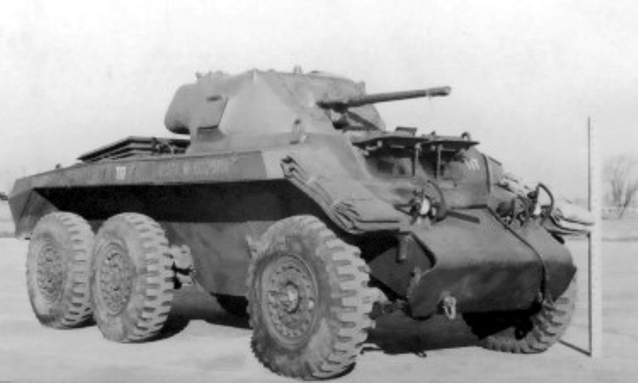
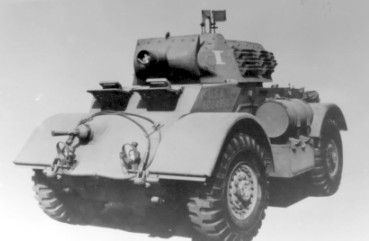
Requirements for the armored car T17 were drawn up and the automotive industry contacted to submit designs. A 6-wheel design submitted by the Ford Motor Company and a 4-wheel design submitted by the Chevrolet Division of General Motors Corporation showed equal promise. One pilot model of each was authorized; the Ford 6-wheel vehicle being designated the T17 and the Chevrolet 4-wheel design the T17E1.
|
||
|
The armored car T17 carried a crew of four men and weighed 28,390 pounds (13,343kgs) loaded. The frontal armor was 1.25 to 2-inch (31.75-50.8mm), side armor was .75 and .875-inch (19-22.2mm), rear armor was .75-inch (19mm), and the turret armor stepped down from 2-inch (50.8mm) frontal to .5-inch (12.7mm) top. The car carried a 37mm gun and a caliber .30 machine gun, in a combination mount M24, in the turret with a 360-degree traverse. Drive was on all six wheels, and turret traverse was by hydraulic power mechanism or by hand. A gyrostabilizer maintained gun position while the vehicle was in motion. A periscope with a telescope was mounted with the 37mm gun and two periscopes were provided for the driver and assistant driver. Tires were 12.00x20, and the speed of the vehicle was 55 miles an hour (88.5km/h).
|
||
|
The original Ford design included two 90-horsepower Ford engines as a power plant, and was based on the use of face-hardened rolled armor plate. In the interest of standardization the 110-horsepower Hercules JXD engine as used in scout car M3A1 and 2.5-ton trucks was used instead of the Ford engine, and to permit welding of the plate, homogeneous armor plate was used. The first pilot was produced in March 1942.
|
||
|
Production of 2,260 vehicles was authorized in January 1942, to be constructed at the St. Paul, Minnesota, Branch of the Ford Motor Company. Production of 1,500 additional vehicles was authorized in June 1942, making a total commitment of 3,760 vehicles. Cancellation of armored car T17 was recommended by the Armored Vehicle Board in December 1942. The Ford Company was; however, authorized to build 250 armored cars T17 to bridge the interval to production of light armored car M8.
|
||
|
These 250 vehicles were assigned to International Aid to the British. On the basis of tests made by the Desert Warfare Board on six armored cars T17 the British decided that the vehicles were not suitable for their use. The cars, minus the 37mm gun, were assigned to military police units in this country, and the project was terminated finally in February 1944. |
||
|
|
||
|
|
||
|
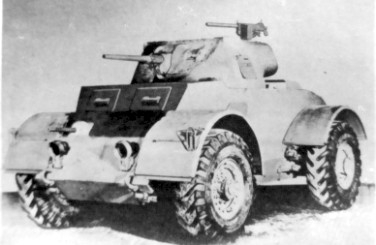
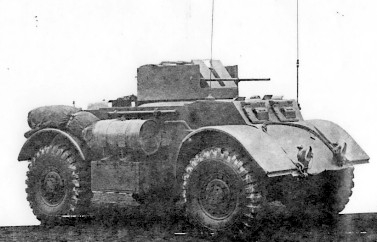
The armored car T17E1 (Staghound 1) proposed by the Chevrolet Division of General Motors Corporation was a 4x4 car powered by two GMC engines located behind the turret. The procurement of one and later two pilot models was approved in October and November of 1941. Production of 2,000 vehicles was authorized in January 1942, and production of 1,500 additional vehicles was approved in April 1942. A requisition by the British Purchasing Commission for 300 armored cars T17E1 of 15 December 1941 was confirmed in March 1942. The first production vehicles were delivered in October of that year. Difficulties in obtaining machine tools and numerous engineering changes resulted in the acceptance of only 157 vehicles in 1942.
|
||
|
Termination of production of this vehicle was recommended by the Special Armored Vehicles Board in December 1942, since none of the using arms represented on that Board desired to be equipped with this vehicle. Tests of the T17E1 were made by the Desert Warfare Board in February 1943 at the request of the British Army Staff. These showed this vehicle more mechanically reliable than the armored car T17. In consequence, all production was taken over by the British, under International Aid.
|
||
|
Production in 1943 was in accordance with schedule and a total of 2,687 vehicles were accepted in that year. With the designation of the T17E1 with the Frazier-Nash turret as the T17E2, 500 T17E1 vehicles were canceled and 500 T17E2 vehicles substituted therefore, and an additional production order issued for 500 T17E2 cars. Production of the armored car T17E1 was terminated in December 1943.
|
||
|
|
||
|
The armored car T17E2 consisted of the Frazier-Nash twin caliber .50 turret, as manufactured by the Norge Division, Borg-Warner Corporation, for British torpedo boats, installed in an armored car T17E1 hull. Design studies were made by the Chevrolet Division, General Motors Corporation. A new turret race was designed and the turret armor and turret basket redesigned. Tests showed the need of a power booster ammunition feed and a better gunsight. These were installed. The first production model was completed in September 1943, tested at Fort Know, a few minor changes made and final tests made by the Antiaircraft Artillery Board at Camp Davis, North Carolina, in December 1943.
|
||
|
Production of this vehicle ended in April 1944, with 211 vehicles accepted in 1943 and a total of 789 vehicles accepted [789 vehicles accepted in 1944 plus the 211 in 1943 for a total production run of 1,000]. |
||
|
|
||
|
|
||
|
The Armored Car T17E3. Built at the request of the British for a large caliber gun on the armored car T17E1 to overcome road blocks, consisted of the 75mm howitzer motor carriage M8 turret mounted on the T17E1 hull. The same turret race was used on both vehicles. The trial installation in October 1943 proved successful, as were proof-firing tests conducted in December 1943. As the British request for 100 vehicles lacked final approval by Army Services Forces, no pilot model complete with stowage and all details was built, and the requirement for this vehicle ceased in late December 1943.
|
||
|
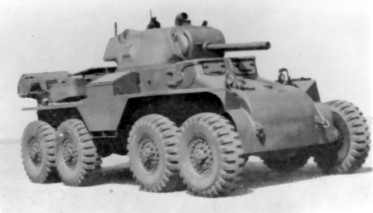
The armored car T18 resulted from the general characteristics of the heavy armored car as projected in July 1941 in accordance with the desires of the Armored Force and the British. These characteristics were those of a wheeled armored vehicle with 360 degree turret, power-operated, and stabilized gun mount, weighing about 32,000 pounds (14,528kgs), and carrying one 37mm gun, or a heavier piece if practicable, in combination mount with one caliber .30 machine gun, and one caliber .30 machine gun in a bow mount. The proposed armor was upon a 2-inch (50.8mm) basis for frontal plates of hull and turret, and sides and rear 1 to 1.25-inch (25.4 – 31.75mm). A speed of 50 miles an hour (80.5km/h) was desired, and not less than 300 miles (482.7km) of action. The power plant was to be diesel or gasoline, with diesel preferred.
|
||
|
Two pilots each of two designs were to be procured from Yellow Truck and Coach Division, General Motors Corporation. The first, designated armored car T18, was an 8x8 vehicle, conventionally sprung, with dual engines in the rear, and mounting a 37mm light tank turret. The second, designated armored car T18E1, was a 6x6 vehicle with individually sprung wheels. The project for this vehicle was, however, suspended in favor of the development of armored car T19. [No pilot of the T18E1 was actually completed].
|
||
|
|
||
|
Agreement was reached in May 1942, between the British Tank Mission and the United States Tank Committee that the T18 design should be modified to provide for the mounting of the 57mm gun instead of the 37mm gun, One armored car T18 was to be completed without modification. The second pilot, designated armored car T18E2, was modified to mount the 57mm gun, M1 with other changes required by this change in armament. These changes increased the weight of the vehicle from an estimated 36,000 pounds (16,344kgs) to approximately 50,000 pounds (22,700kgs) and made necessary a change from 12.00x20 tires to 14.00x20 tires. The hydromatic transmission intended for the lighter vehicle proved unsatisfactory and a torque converter type transmission was substituted.
|
||
|
Design changes delayed production of the vehicle until December 1942. By recommendation of the Special Armored Vehicle Board the armored cars T18, T18E1, and T18E2 projects were closed, since these vehicles were too heavy for reconnaissance use.
|
||
|
The original production order of 3 February 1942 covered 2,500 armored cars T18, without armament, placed with the Yellow Truck and Coach Division of General Motors Corporation. On 18 March 1942 an additional production order for 300 T18 vehicles were issued. The original schedule for production of the T18 in 1942 was; June 5, July 10, August 15, September 50, October 100, November 200, December 250, Total 630 units.
|
||
|
The revised forecast for the production of armored car T18E2 for 1942 was; September 5, October 10, November 15, December 50, Total 80 units.
|
||
|
|
||
|
Because of the difficulties in obtaining a source for the 57mm gun mount, deliveries of first vehicles were slowed. Further causes of delay were tool bottlenecks and difficulty in obtaining acceptable clutch throwout bearings.
|
||
|
No requirement for this car appeared on the Army Supply Program in November 1942. Production had, however, progressed to the point where complete cancellation was inadvisable, and procurement of 30 vehicles plus one quarter set of spare parts for concurrency and an additional one quarter set of spare parts for all-time buy was authorized. All vehicles under this program were furnished the British under International Aid.
|
||
|
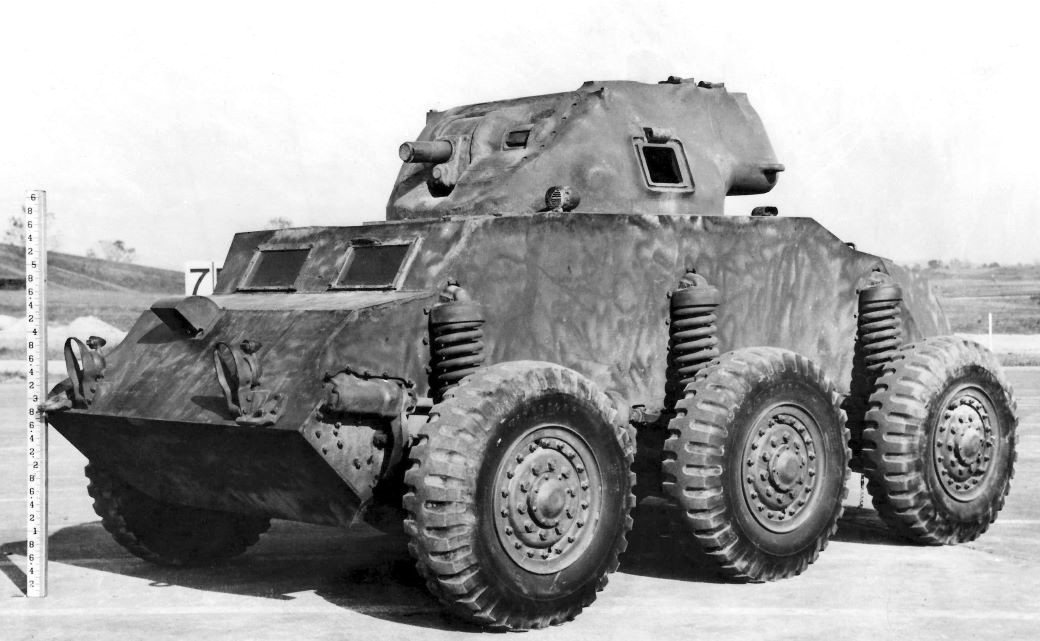
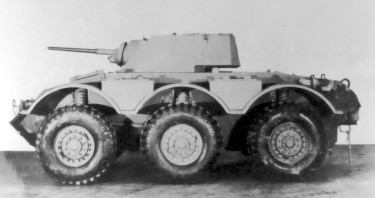
The armored car T19 was a 6x6 car with independently sprung wheels and was an attempt to provide improved rideability over the then current 4x4 and 6x6 designs of conventional axle arrangement. Construction of two pilot models by the Chevrolet Division, General Motors Corporation was authorized 29 January 1942. |
||
|
|
||
|
|
||
|
One pilot was built using two GMC truck engines with hydromatic transmissions as used in the armored car, T17E1. The second pilot was modified to provide a vehicle not in excess of 28,000 pounds (12,712kgs) weight, using 14.00x20 tires, and with the power plant similar to that of the light tank, M5. The armor of the vehicle was to be front .5-inch (12.7mm) at 45° slope, sides .375-inch (9.53mm), and top, bottom, and rear .25-inch (6.35mm). The turret armor was to have the same basis as the hull armor. Armament was to consist of one 37mm gun and one caliber .30 machine gun mounted coaxially, and one caliber .30 bow machine gun. The vehicle was simplified by having no turret basket, no gyrostabilizer, and traverse was by hand only. Top speed was to be 55 miles an hour (88.5km/h), and the car was to have a radius of action of 300 miles (482.7km). This second pilot was designated armored car, T19E1.
|
||
|
|
||
|
This vehicle was developed at the request of the Armored Force. The Tank Destroyer Command desired a vehicle mounting the 75mm Gun, M3 and based on the T19E1 chassis. This was to mount the 75mm gun, in a modified combination mount M34 in an open top turret with an elevation from minus 10 degrees to plus 20 degrees, a traverse of 40 degrees to front for firing, and of 360 degrees for traveling. Further armament was to be a caliber .50 machine gun, M2 HB Flexible for antiaircraft and ground use. The armor was to be about that of the T18E1, with turret frontal armor of 1-inch (25.4mm) with gun shield, sides and rear .5-inch (12.7mm), and top without armor. The construction of one pilot vehicle was authorized, and the vehicle designated the 75mm gun motor carriage, T66.
|
||
|
|
||
|
The report if the Special Armored Vehicle Board, in December 1942, recommended that further development of the armored cars, T19 and T19E1 be terminated, and that the Board did not consider the T19E1 suitable for development as a gun motor carriage. While it was felt that the chassis offered possibilities for successful use as a command car, personnel-cargo carrier, antiaircraft gun motor carriage, gun or howitzer motor carriage, or as a prime mover for the 4.5-inch gun or the 155mm howitzer, it was recommended that the projects for the armored cars, T19 and T19E1 and the 75mm gun motor carriage T66 be closed.
|
||
|
The vehicles were subsequently tested at Aberdeen Proving Ground, and at Camps Seeley and Young, California. The armored cars, T19 and T19E1 were scrapped. The 75mm gun motor carriage T66 was retained at Aberdeen Proving Ground.
|
||
|
The armored car T20 was a gas-electric drive vehicle conceived by a Mr. O.F. Quartullo. The Armored Force became interested in the vehicle, as a possible substitute for the armored car T13, the construction of four pilot models was authorized 12 March 1942. Two of these vehicles were to be used as the basis of armored cars and two as the basis for 105mm howitzer motor carriages.
|
||
|
The vehicle as proposed was an 8-wheel, 8-wheel drive design, with each wheel independently sprung and driven by a separate motor. The power train consisted of a gasoline engine driving a generator, which delivered current to the wheel driving motors though a control mechanism. The vehicle, as planned, was to weigh about 26,000 pounds (11,804kgs), carry a crew of five men, to have armor from .375 to .625-inch (9.5-15.9mm) in thickness, and to carry one 37mm gun in combination with a caliber .30 machine gun with an elevation of minus 10 degrees to plus 45 degrees in a 360 degree power-operated turret, and one caliber .30 machine gun in a ball mount for use of the assistant driver. The vehicle was to have a road speed of 60 miles an hour (96.5km/h) and a radius of action of 500 miles (804.5km).
|
||
|
Contract with Midland Steel Products, Cleveland, Ohio for the construction of two armored cars, with the option for two additional cars, was delayed by engineering difficulties. The Electric Individual Drive Company was formed to carry on the project. A report on the engineering features of the vehicle was made by Westinghouse Electric and Manufacturing Company. The steer-ability of the car was a questionable feature. The vehicle was mote than three tons overweight. It was estimated that it would require approximately 18 months to complete this pilot and start production. In June 1942 the Armored Force stated that it was interested only in a vehicle of this type that could be completed in 1942 or early 1943. In view of the difficulties mentioned the project for armored car T20 was closed 6 August 1942.
|
||
|
|
||
|
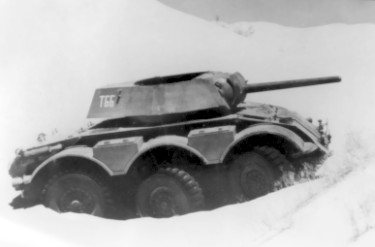
The 3-inch gun motor carriage T55 was an 8x8 vehicle known as the “Cook Interceptor” and commercially developed to fulfill the purpose of an armored car, tank destroyer, or gun motor carriage. Contract for development was negotiated 1 August 1942 and a pilot model demonstrated before the Special Armored Vehicle Board at Aberdeen Proving Ground. This pilot showed flotation superior to the other wheeled vehicles tested. The Board recommended however that no further consideration be given this or other wheeled tanks or gun motor carriages. In order to complete the contract more satisfactorily the pilot was redesigned and subsequently tested at the Desert Proving Ground. The report confirmed the conclusions of the Special Armored Vehicle Board and the pilot was sent to Aberdeen Proving Ground for historical record. The pilot was later used to demonstrate its suspension principle in connection with the development program on heavy transport vehicles. The T55 project was closed 1 April 1943.
|
||
|
|
||
|
|
||
| Return to Article Index | Next Page | |
|
Copyright: David Haugh - August 2006 |
||
.jpg)
.jpg)
.jpg)
.jpg)